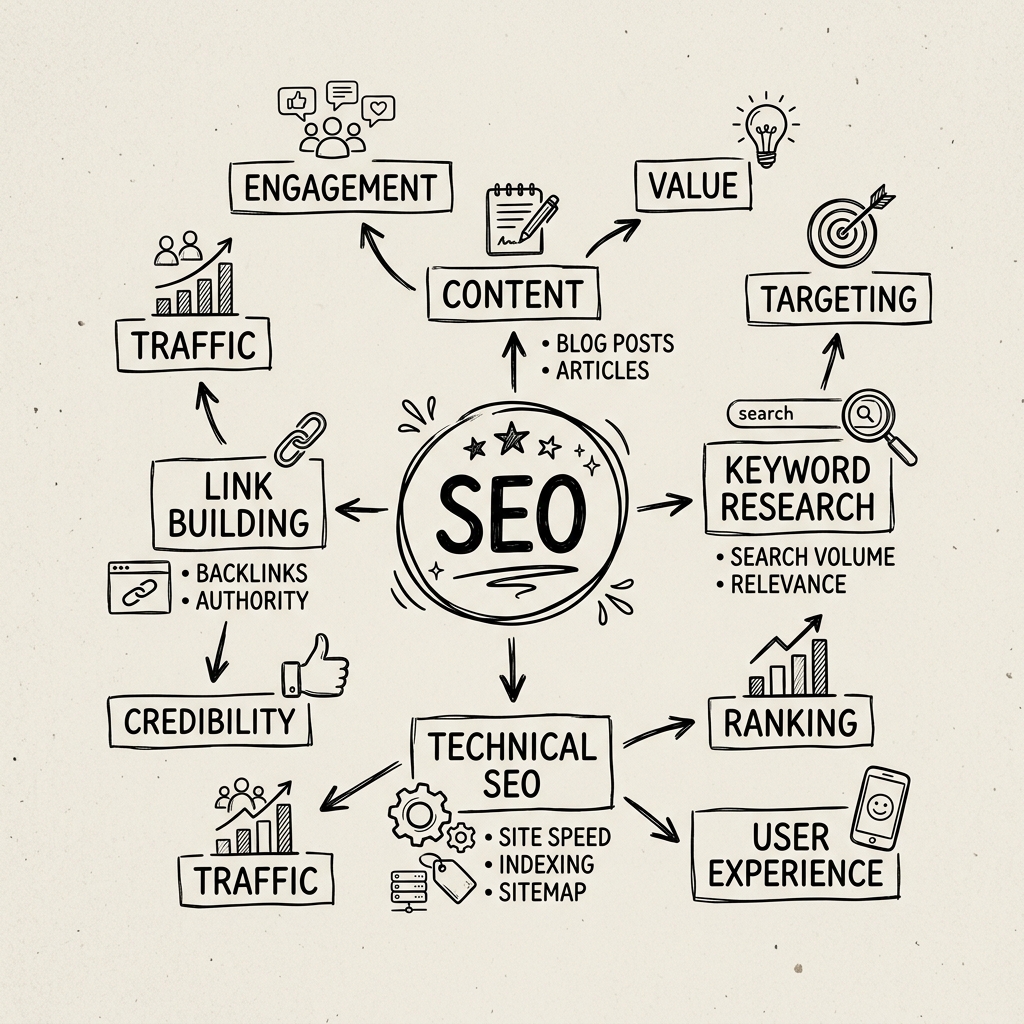
SEO Best Practices for Modern Websites in 2025
Learn the essential SEO strategies that can help your website rank higher in search engines and attract more organic traffic.
Search engines have become the default starting point for almost every digital journey. Whether someone is looking for a software vendor, a local restaurant, or an answer to a technical question — Google is the first stop. For businesses, this means one thing: ranking well isn’t optional, it’s existential.
But SEO in 2025 looks very different from what it did five years ago. The old playbook of keyword stuffing and backlink farming has been replaced by something more demanding — and more rewarding: building genuinely useful, technically sound digital experiences.
The Foundation: Technical SEO
Before crafting a single piece of content, the technical foundation of a website determines whether any of that effort will be indexed and surfaced correctly.
The most critical technical factors today include:
- Core Web Vitals — Google’s three pillars of user experience (LCP, INP, CLS) are now direct ranking signals
- Mobile-first indexing — Google indexes the mobile version of your site before the desktop version
- HTTPS — Non-negotiable for trust and ranking
- Structured data (Schema.org) — Helps search engines understand the context of your content
- Canonical URLs — Prevents duplicate content from diluting authority
A fast, mobile-responsive, well-structured site isn’t a “nice to have” — it’s the baseline.
Content That Actually Ranks
The algorithm has become remarkably good at distinguishing content written for search engines from content written for people. The latter wins, consistently.
Google’s E-E-A-T framework (Experience, Expertise, Authoritativeness, Trustworthiness) now guides how content quality is evaluated. In practice, this means:
- Write with depth, not just length — A 600-word article that fully answers a question beats a 3,000-word article that circles it
- Demonstrate real expertise — Cite sources, show data, provide examples from actual experience
- Keep content fresh — Regularly updated content signals relevance to both users and crawlers
- Match search intent — Understand whether the user wants to learn, compare, or buy, and structure your content accordingly
Keyword Strategy in the Age of Semantic Search
Modern search engines understand meaning — not just the exact words used. This shift toward semantic search changes how keyword research should be approached:
| Old Approach | Modern Approach |
|---|---|
| Target exact-match keywords | Target topic clusters and intent |
| Repeat keywords throughout content | Use natural language variations |
| Build as many backlinks as possible | Earn backlinks through genuinely useful content |
| Optimize one page per keyword | Build comprehensive topic authority |
The best keyword strategy isn’t about what you type into a spreadsheet — it’s about deeply understanding what your audience is trying to accomplish.
Local SEO: The Underutilized Advantage
For Indonesian businesses, local SEO is often the highest-ROI channel that gets the least attention. Optimizing a Google Business Profile, gathering authentic reviews, and ensuring consistent NAP (Name, Address, Phone) data across directories can dramatically improve visibility for location-specific searches.
Measuring What Matters
Rankings are a vanity metric. What matters is whether SEO efforts are translating into real business outcomes. Track:
- Organic traffic growth (Google Search Console, GA4)
- Click-through rate (CTR) by page — a proxy for how compelling your titles and descriptions are
- Conversion rate from organic channels — Is the traffic actually qualified?
- Core Web Vitals scores — A degrading score is an early warning signal
SEO is a long game. But the businesses that treat it as an investment — rather than a checkbox — are the ones that build durable, compounding organic growth.
The SEO-to-Conversion Gap Most Businesses Ignore
Ranking on page one is a victory. But the real challenge begins when that traffic lands on your site — and your backend can’t handle the demand it generates. Leads come in through forms but disappear into inboxes. Sales inquiries aren’t tracked. Follow-ups are manual and inconsistent.
SEO brings people to the door. Whether they walk in and stay depends on what happens next — and that requires operational systems that are just as sharp as your content.
At Gilabs, we help businesses close that gap. Alongside technical SEO work, we build integrated business systems — CRM, ERP, POS, and Finance in one platform — that ensure every lead captured through organic search gets actioned, tracked, and converted. We move fast: your first working prototype is ready in weeks, not the quarters that most enterprise vendors quote.
Want to turn better rankings into operational results? Let’s talk — from SEO audit to integrated CRM, we’ve got you covered.
Key Takeaways
- • Core Web Vitals (LCP, INP, CLS) are now direct Google ranking signals — not optional
- • E-E-A-T: write with genuine depth and expertise, not just keyword density
- • Match search intent — understand if the user wants to learn, compare, or buy
- • Local SEO is consistently the highest-ROI channel that Indonesian businesses underinvest in
- • SEO brings traffic to the door — a CRM system ensures every lead actually gets followed up