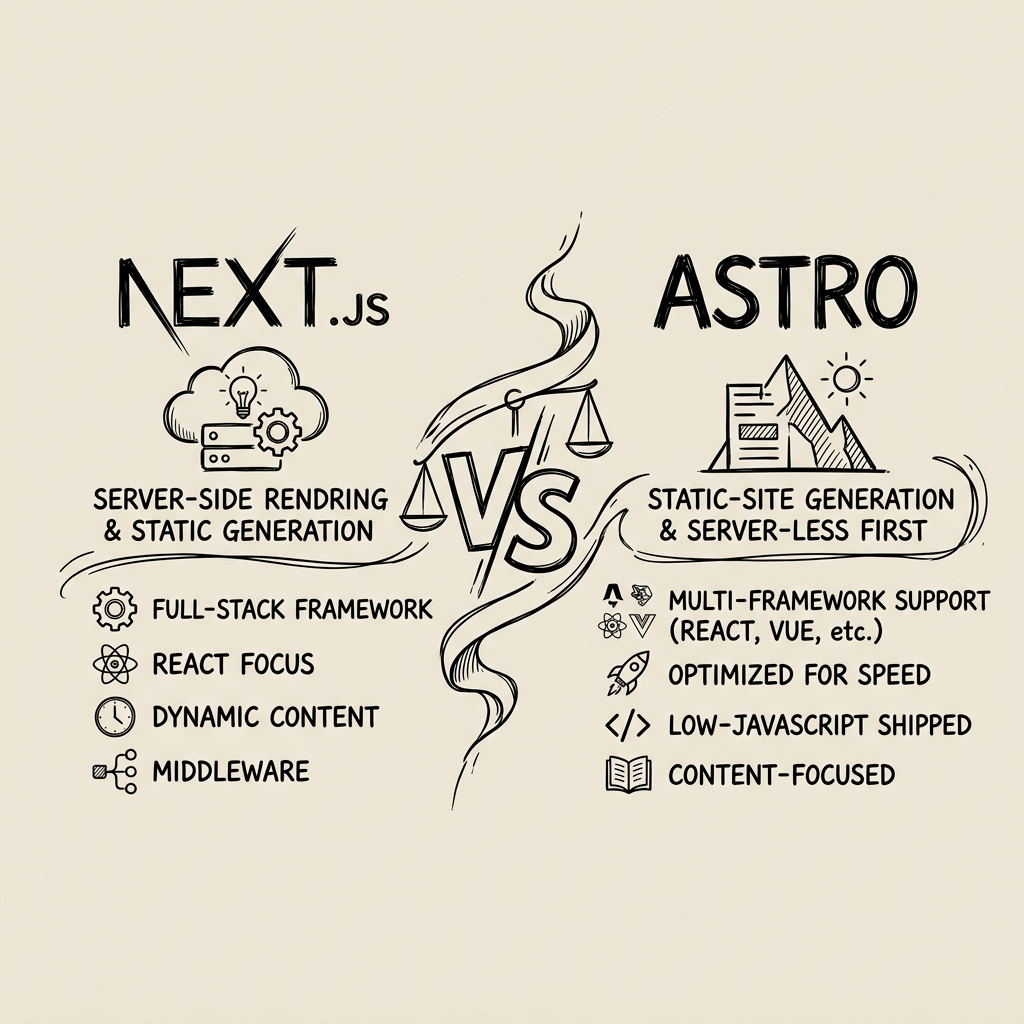
Next.js vs Astro: Choosing the Right Framework for Your Project
Compare Next.js and Astro to understand which framework best suits your project needs, from static sites to dynamic applications.
Picking the wrong framework at the start of a project is one of the most costly mistakes a development team can make. The decision often shapes everything — from deployment architecture, to developer experience, to how easily the site can be iterated on over time.
In 2025, two frameworks dominate the conversation for modern web development: Next.js and Astro. Both are excellent. But they solve different problems, and understanding those differences is the difference between a project that thrives and one that fights its own tooling.
The Core Philosophy That Separates Them
Next.js was built around the idea of a full-stack React framework. It excels at dynamic applications where content changes frequently, user authentication is required, or server-side logic needs to run close to the edge.
Astro, on the other hand, was designed with a radical premise: ship zero JavaScript by default. It’s built for content-heavy sites where performance and SEO are the primary concerns — and where interactivity is the exception, not the rule.
This single distinction cascades into every other difference.
Feature Comparison
| Feature | Next.js | Astro |
|---|---|---|
| Rendering | SSR, SSG, ISR, Edge | SSG, SSR (opt-in) |
| JavaScript Sent to Client | React runtime + components | Near zero (by default) |
| Routing | File-based (App Router) | File-based |
| UI Framework | React only | Framework-agnostic (React, Vue, Svelte, etc.) |
| API Routes | Built-in | Via adapters |
| Best For | Web apps, dashboards, e-commerce | Blogs, marketing sites, documentation |
| Learning Curve | Moderate–High | Low–Moderate |
When to Choose Next.js
Next.js is the right call when:
- Your application requires real-time or frequently updated data
- You’re building something with authenticated user sessions
- You need API routes baked directly into the framework
- Your team is already deeply invested in the React ecosystem
- You’re building a dashboard, SaaS product, or e-commerce platform
The App Router introduced in Next.js 13+ brought Server Components to the mainstream — making it even more compelling for full-stack applications where performance and data-fetching are tightly coupled.
When to Choose Astro
Astro is the right call when:
- Performance and SEO scores are non-negotiable
- The site is primarily content-driven (blog, corporate profile, documentation)
- You want the flexibility to use multiple UI frameworks in a single project
- Your team prefers writing closer to standard HTML
- You value simplicity in the build pipeline
Astro’s Islands Architecture is particularly brilliant — it allows you to hydrate only the specific components that need interactivity, leaving the rest as raw HTML. The result is Lighthouse scores that consistently hit 100 across the board.
A Real-World Decision Framework
Is the site primarily content-focused?
├── Yes → Does it need real-time data or auth?
│   ├── No  → Astro is likely the better choice
│   └── Yes → Consider Astro + external auth/API
└── No → Is it a full application (dashboard, SaaS)?
    └── Yes → Next.js is the stronger foundation
Our Take
At Gilabs, we use both — strategically. Company profiles, landing pages, and blogs almost always run on Astro (this site included). Client dashboards, CRM tools, and SaaS platforms run on Next.js.
The best framework is the one that aligns with the nature of the project, not the one that’s trending on social media.
When the Framework Decision Is the Least of Your Problems
For many businesses we work with, the deeper challenge isn’t choosing between Next.js and Astro — it’s the realization that they’re managing their operations across a patchwork of disconnected tools: a CRM that doesn’t talk to their POS, a finance dashboard living in spreadsheets, and inventory tracked in a separate system.
The framework powers the interface. But the real ROI lives in the integration layer — where your data flows seamlessly between sales, operations, and finance.
Gilabs builds integrated business platforms — combining CRM, ERP, POS, and Finance in one unified system — using the right frontend framework for each module. The advantage? You get a working prototype rapidly, so decision-makers can validate the system against real workflows before significant investment is committed.
Not sure where to start? Let’s talk architecture — we’ll guide you from framework decision to working system, faster than you’d expect.
Key Takeaways
- • Astro ships near-zero JavaScript by default — ideal for content-heavy, SEO-critical sites
- • Next.js is the stronger foundation for apps with auth, real-time data, or API routes
- • The best framework aligns with the project's nature, not what's trending on social media
- • Frontend framework choice matters less than the integration layer connecting all your business data
- • A unified CRM + ERP + POS backend turns any frontend into a complete business system