Mobile App Development with Flutter: One Codebase, Multiple Platforms
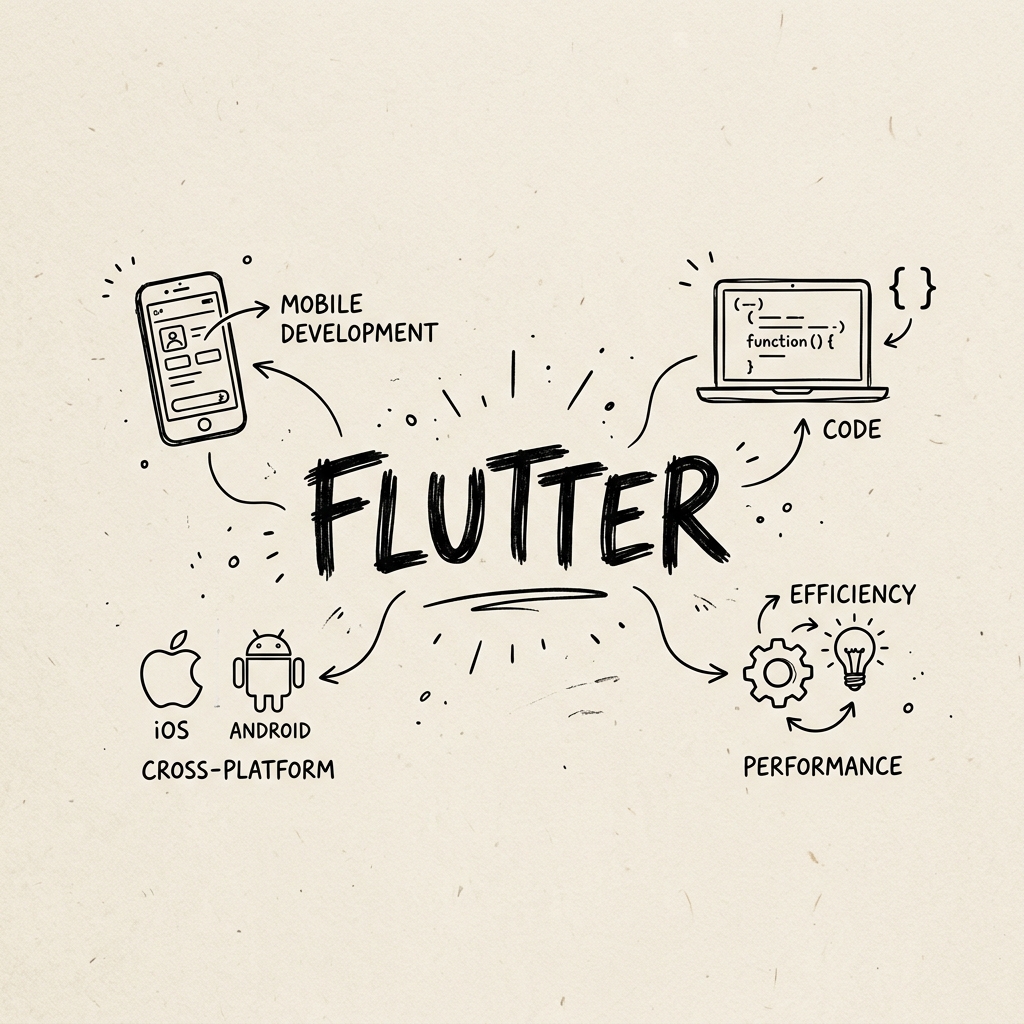
Explore how Flutter enables rapid cross-platform mobile development, allowing you to build beautiful apps for iOS and Android from a single codebase.
There was a time when building for iOS and Android meant maintaining two entirely separate codebases, two teams, and twice the budget. Flutter changed that equation — fundamentally.
Released by Google and now widely adopted across the industry, Flutter allows developers to write code once and deploy it natively on iOS, Android, web, and even desktop. The result: faster delivery, consistent user experience, and significantly lower development costs.
What Makes Flutter Different
Most cross-platform solutions compromise on performance or UI fidelity. Flutter doesn’t. Instead of relying on a web view or bridging native components, Flutter renders its own pixel-perfect widgets using its own graphics engine (Skia / Impeller). This means:
- Animations run at 60–120fps natively
- The UI looks identical on both platforms
- There’s no JavaScript bridge introducing latency
For users, this translates to an app that feels native — because in many meaningful ways, it is.
The Business Case for Flutter
For startups and businesses launching new digital products, Flutter offers a compelling proposition:
“Why build and maintain two apps when one codebase can serve both audiences from day one?”
The numbers tell the story clearly:
| Metric | Native (iOS + Android) | Flutter |
|---|---|---|
| Development Time | ~6–12 months | ~3–6 months |
| Team Size Required | 2 separate teams | 1 unified team |
| Code Reuse | ~0% | ~85–95% |
| Maintenance Overhead | High | Moderate |
This is particularly relevant for products targeting diverse Indonesian users — where both iOS and Android have significant market share.
When Flutter Is the Right Choice
Flutter shines in scenarios where:
- Time-to-market is a priority — You need to validate your product quickly across platforms
- Budget is finite — Maintaining a single codebase is dramatically more affordable
- Brand consistency matters — Custom, pixel-perfect UI that matches your design system
- Long-term scalability is planned — Flutter’s architecture supports growth elegantly
It’s worth noting that Flutter may not be ideal for apps requiring deep system-level access (e.g., VPN clients, complex Bluetooth integrations) — in those cases, some native modules may still be needed.
How Gilabs Approaches Flutter Development
At Gilabs, Flutter isn’t just a tool — it’s at the core of how we build mobile experiences. Our workflow emphasizes:
- Architecture-first thinking — Clean separation between UI, business logic, and data layers
- Design system integration — Consistent components that align with brand guidelines
- Performance profiling — Regular audits to ensure smooth, responsive experiences
- Iterative delivery — Shipping working features in sprints, not months-long development silos
The outcome is a mobile app that users don’t just tolerate — one they genuinely enjoy using.
Beyond the App: Connecting Mobile to Your Business Core
A mobile app without a connected backend is a missed opportunity. The most common pain point we see from businesses post-launch isn’t the app itself — it’s the disconnect between what happens on the mobile front-end and the back-office operations. Sales recorded in the app don’t sync to inventory. Customer data stays siloed. Finance teams still work from spreadsheets.
A great mobile experience is only half the equation. The other half is having the backend systems that make the data actionable.
At Gilabs, our Flutter development doesn’t happen in isolation. It’s part of a broader ecosystem — connecting to an all-in-one platform covering CRM, ERP, POS, and Finance — so the data that flows through your mobile app becomes immediately useful across your entire operation. And because we prioritize rapid prototyping, your team can validate the end-to-end flow — mobile to backend — within the first few weeks of engagement.
Ready to build a mobile experience that’s connected end-to-end? Let’s map it out together — we’ll have a working prototype in your hands before you know it.
Key Takeaways
- • Flutter renders its own pixel-perfect widgets — no compromise on performance or UI fidelity
- • One codebase can serve iOS and Android with 85–95% code reuse, cutting dev time in half
- • A mobile app without a connected backend is a missed business opportunity
- • Integrating Flutter with an ERP/CRM backend turns front-end interactions into immediate operational insight
- • Rapid prototyping means you validate the end-to-end flow in weeks, not months